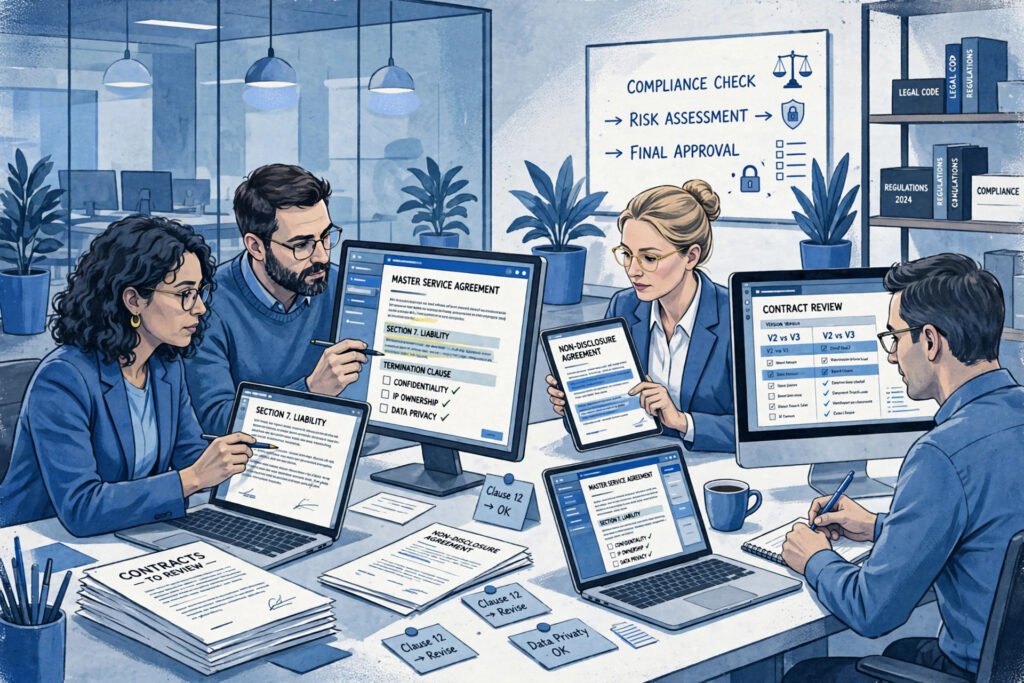
Contract delays ripple quietly through a business. A sales deal waits for paperwork, a procurement order sits unsigned, and a partnership launch stalls because the agreement is still moving from inbox to inbox. Legal teams feel the pressure, but the harder question is where the time disappears. When requests, review stages, approval waits, revisions, and pending tasks live in scattered systems, it becomes very difficult to see which part of the process loses the hours.
That is the gap contract analytics closes. By studying contract data in one place, legal teams can spot slow points, understand their causes, and make targeted changes that move contracts from request to signature with less delay. This guide explains how contract analytics helps legal teams reduce contract turnaround times and how the benefits show up in everyday legal work.
Key Takeaways
- Contract analytics turns contracts into structured data, showing legal teams where each agreement spends its time.
- Measuring time per stage, approval waits, revision counts, and volume reveals bottlenecks that single records hide.
- Teams use these insights to fix approval flows, build clearer templates and playbooks, and plan staffing around real demand.
- A central view cuts manual tracking and gives business stakeholders visibility without constant status requests.
A single contract can pass through many hands before anyone signs it: intake, business review, legal review, risk assessment, negotiation, approvals, and signature. Each handoff is a chance for progress, but also for delay. A request may sit in a queue, wait for a traveling approver, or pause while a business owner supplies missing details. When small pauses multiply across dozens of agreements, average turnaround time grows.
The frustrating part is that teams often know contracts are slow without knowing why. One agreement may wait on an approver while another is stuck in negotiation over the same disputed clause that appears in every deal. Treating both cases the same way never fixes the real issue. A stage-by-stage view changes this, moving the team from guessing about delays to diagnosing causes. Reducing turnaround time rarely means asking lawyers to work faster. It usually means removing the waiting, repeated work, and blind spots that slow everything down.

What Is Contract Analytics, Explained in Plain Terms?
Contract analytics is the study of contract data to find trends, risks, obligations, and performance patterns. Instead of treating contracts as documents that get filed and forgotten, analytics tools read agreements, identify clauses, extract key terms such as dates, parties, and values, and organize everything into a format that can be searched and measured across the whole portfolio.
The technology behind it is increasingly practical. AI and machine learning power the extraction, natural language processing interprets legal language clause by clause, and optical character recognition makes scanned documents readable. The core idea matches other data technologies: turning raw inputs into structured data people can analyze, a concept well illustrated by how point cloud technology turns raw images into structured 3D data.
Risk scoring is one of the most useful capabilities. Contracts built from playbook-approved clauses score low, while agreements packed with non-standard terms, uncapped liability, or vague termination language score higher. Scoring aims limited review hours at the agreements carrying the most exposure, while low-risk standard deals take a lighter path. That triage is one of the simplest ways analytics shortens average turnaround time.
Why Do Contracts Take So Long to Close?
Contracts take so long to close because each agreement moves through many separate stages, and every stage can introduce its own delay.
A request often arrives with incomplete information. The contract then goes through legal review, risk assessment, and negotiation, followed by internal approvals that stall when routing is unclear. Without data, every delay looks the same from the outside. Business teams send status requests, legal staff interrupt review work to answer them, and the process slows further. Analytics breaks this cycle by showing each stage separately, so the actual cause of a pause becomes visible.
How Does Contract Analytics Help Legal Teams Find the Stages Where Contracts Slow Down?
Contract analytics finds slow stages by measuring time at every step of the contract journey and comparing the results, so bottlenecks show up as data instead of guesses.
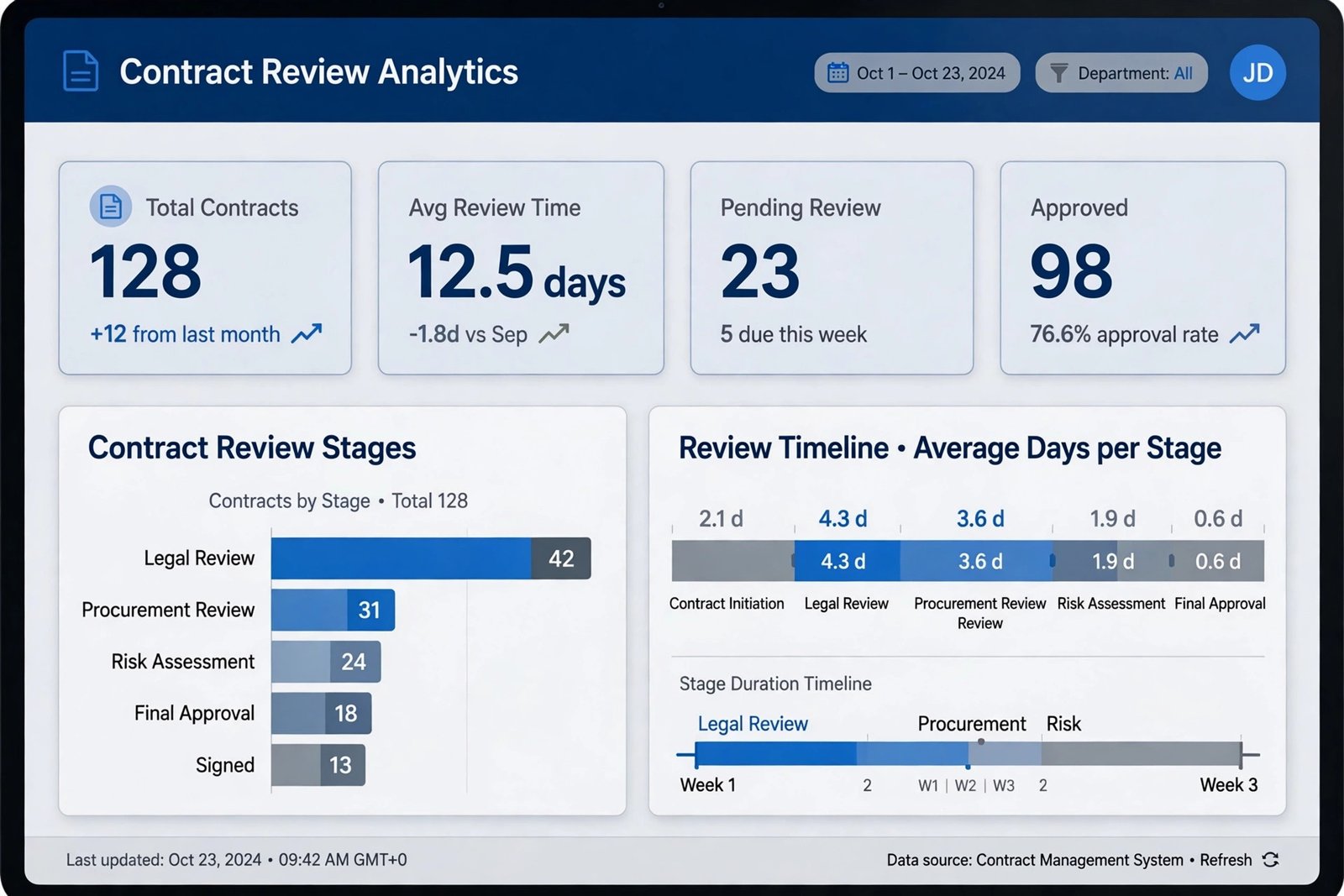
The most useful metrics are straightforward: time spent in each review stage, approval wait times, revision counts, request volume, average time from request to completion, and contracts open beyond expected timelines. This view reveals patterns individual records hide. If approvals take longer than legal review, the fix is probably a new approval flow, not more lawyers. If one clause type drives most redlines, the answer is a clearer template or playbook. One legal operations team found that contracts needing finance approval took noticeably longer than standard ones, and redesigning that path cut real days off their cycle.
- Time per review stage: shows which step consumes the most calendar days.
- Approval wait times: separates approver delays from actual legal work.
- Revision counts: flags clauses generating repeated rework.
- Request volume trends: shows when demand spikes and queues form.
- Request-to-signature average: tracks whether changes actually speed things up.
- Aging contracts: surfaces agreements quietly going stale.
How Can Legal Teams Turn Contract Data Into Faster Workflows?
Better data only helps when it leads to a better process, so teams use analytics insights to redesign the workflow around the slowest stage.
If contracts routinely wait on the same approval, the team can ask whether the right people are involved at the right point. Approvals for standard deals can sometimes be delegated, and stakeholders who rarely change anything can move to an FYI step instead of a gate. If repeated revisions drive delays, analytics points at the common negotiation points behind them, and legal teams can create clearer templates and playbooks with approved fallback positions. Every dispute settled by a playbook instead of a fresh review is time saved.
Analytics also helps teams compare workload patterns over time. When data shows which periods bring the heaviest volume, leaders can plan staffing and balance assignments before a backlog forms. Managing capacity from actual work patterns, rather than guesswork, keeps turnaround times steady even when demand spikes.
How Does Manual Review Compare With an Analytics-Assisted Process?
The contrast becomes clear when each stage of the contract journey is compared side by side.
| Stage | Manual approach | With contract analytics |
|---|---|---|
| Intake and triage | Requests arrive by email; risk level is a guess | Request data feeds risk scoring and routing |
| Legal review | Lawyer reads every document fresh | Standard clauses pre-checked; reviewer focuses on deviations |
| Negotiation | Positions rebuilt from memory | Playbook positions and concession data guide strategy |
| Approvals | Delays surface only when someone complains | Approval times measured; slow gates redesigned |
| Status updates | Staff answer one-off status emails | Shared dashboards show progress; questions drop |
| Reporting | Hours of manual report building | Dashboards generate views on demand |
None of this removes lawyers from the work. Analytics handles the finding, counting, and tracking so that human judgment goes where it matters most. Review expertise is the scarcest resource in most legal departments, and analytics protects it.
Can Contract Analytics Reduce Manual Tracking for Legal Teams?
Yes. Contract analytics reduces manual tracking by replacing scattered spreadsheets and email threads with one central view of contract data.
Teams relying on manual reports must gather information from several places before they can understand workload or turnaround times. A central analytics view brings it together: active requests, review progress, approval stages, and completion trends are visible without opening each contract. The language understanding behind this, powered by advances in modern large language models, is what makes structuring thousands of pages practical. Routine reporting gets easier too, and the hours once lost to chasing updates become hours of actual legal work.
How Do Trend Insights Help Legal Teams Plan Their Workload?
Trend insights help legal teams plan by showing when request volume rises, which work repeats, and where capacity needs to shift before problems appear.
If analytics shows that certain periods bring higher volumes, leaders can review staffing and redistribute work ahead of the surge instead of reacting after the backlog builds. Teams can also route recurring work to standard templates with clearer intake rules, so fewer requests bounce back for missing information. Over time the process learns from itself: every round of data reveals the next inefficiency, and every fix lowers the baseline for the next period.
How Does Contract Analytics Give Business Teams Better Visibility?
Contract analytics gives business teams visibility through a shared view of where each request stands, so stakeholders check progress themselves instead of asking legal for updates.
A delay may sit on the business side: an incomplete request, a pending approval, or a stakeholder who owes more information. A shared view labels the pause by stage, so everyone can see it, and legal teams spend far less time answering status questions. The shared view also creates a common language for improvement, since discussions about where contracts slow down become concrete. Turning those findings into visuals makes them land even harder, and our guide on how to create infographic content to explain new technologies shows how teams translate complex systems into visuals stakeholders actually absorb. Practical technology coverage like this is what The Weird News Blog publishes regularly for readers who want to stay current.
Frequently Asked Questions
What exactly does contract analytics software do?
It reads contracts, identifies clauses, extracts key terms such as dates, parties, obligations, and values, and organizes the results so they can be searched and measured. It also tracks workflow data like review times, approval waits, and revision counts, presenting it in dashboards that legal teams use to find delays and improve processes.
How is contract analytics different from contract management software?
Management software stores agreements and moves them through workflows. Analytics studies the data inside and around those agreements, finding trends, risks, bottlenecks, and performance patterns. The two usually work together: one holds the contracts, the other turns their data into insight.
Does contract analytics replace lawyers?
No. Analytics handles the finding, counting, and tracking across large portfolios, but legal judgment still decides what the data means. The goal is to aim limited lawyer hours at high-risk or complex work while standard agreements take lighter paths.
Which metrics matter most for turnaround time?
Start with time per review stage, approval wait times, revision counts, request volume over time, average time from request to signature, and contracts open beyond expected timelines. These separate real bottlenecks from background noise and show whether process changes are working.
Can small legal teams benefit from contract analytics?
Yes. Small teams feel delays most sharply because every member carries a full load. A central view of contract activity reduces the manual tracking that eats into review hours and makes capacity planning possible without extra headcount.
What should a team look for when choosing a tool?
Look for reliable clause and obligation extraction, clear dashboards for review and approval activity, risk scoring, and integration with existing workflows. The most useful platforms embed analytics into each lifecycle stage, from intake through renewal, so insights drive action instead of sitting in a separate reporting layer.
The Bottom Line
Reducing contract turnaround time is not about rushing legal review. It is about understanding why work slows down and building a process that removes those barriers. When teams can see review times, approval delays, workload trends, and contract activity in one place, they can make targeted changes instead of broad guesses. Turning contract data into usable insight gives legal teams the map they need, and faster, more predictable contracts are the natural result.