
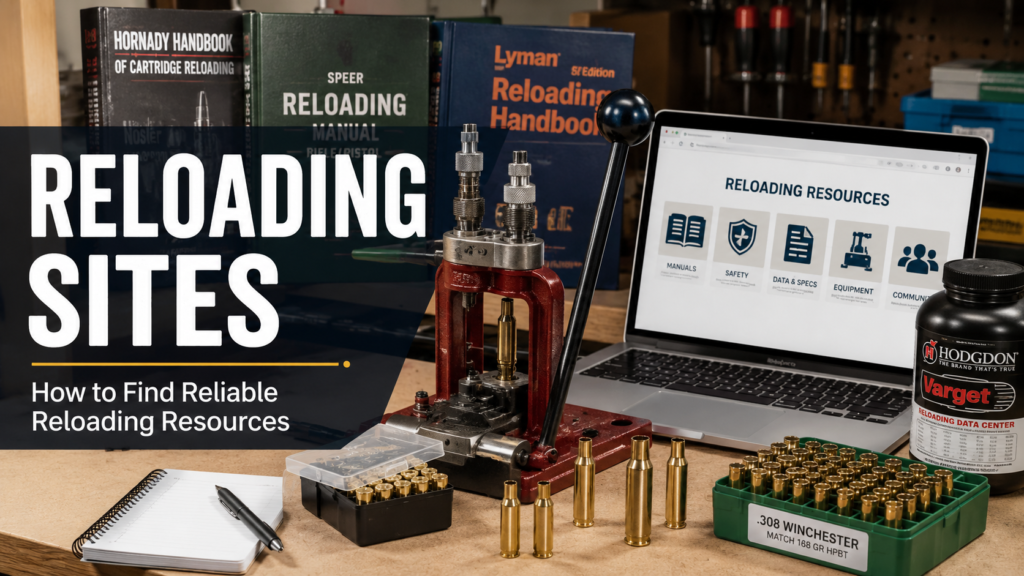
Finding trustworthy reloading sites is not simply a matter of searching Google and choosing the website with the most results. Reloading information involves ammunition components, pressure, equipment, storage, and firearm compatibility, so the quality and authority of the source matter.
For beginners, the biggest challenge is often knowing which websites are useful for learning and which ones should be treated cautiously. A professional manufacturer, recognized standards organization, established manual publisher, or reputable retailer can provide very different information from an anonymous forum or newly created online store.
The good news is that you do not need dozens of websites bookmarked. A small collection of authoritative resources can cover most research needs involved in responsible reloading.
This guide explains what to look for in reloading sites, how to distinguish educational resources from commercial stores, how to recognize questionable websites, and why manufacturer and standards-based information should take priority over unverified internet discussions.
Safety note: Reloading ammunition can involve significant hazards if incorrect components, procedures, or information are used. This article is intended to help readers evaluate online resources, not to provide instructions for manufacturing ammunition. Always follow current manufacturer documentation, applicable laws, and appropriate safety guidance.
What Are Reloading Sites?
Reloading sites are websites that provide information, resources, products, manuals, tools, or communities related to ammunition reloading and handloading.
They can serve very different purposes. Some are operated by component manufacturers and provide official documentation. Others sell reloading equipment and components. Some publish educational articles, while forums allow reloaders to discuss their experiences.
A useful way to categorize them is:
| Type of reloading site | Main purpose |
|---|---|
| Manufacturer websites | Product information, manuals, safety guidance, and official resources |
| Reloading-data publishers | Organized technical reference information |
| Standards organizations | Industry standards and safety information |
| Retailers | Equipment and component purchasing |
| Educational websites | Tutorials, explanations, and background information |
| Forums and communities | Discussions and user experiences |
| Monitoring/comparison sites | Inventory and price tracking |
These categories should not be treated as interchangeable.
A forum post may be useful for discovering that a particular piece of equipment exists, for example, but it should not automatically be treated as equivalent to manufacturer’s documentation.
Why the Quality of Reloading Sites Matters
Reloading is different from many ordinary hobbies because inaccurate information can have serious consequences.
A website can look professional and still provide information that is outdated, incomplete, incorrectly attributed, or unsuitable for a particular firearm or component combination.
The Sporting Arms and Ammunition Manufacturers’ Institute (SAAMI) explains that its standards establish safety, reliability, and interchangeability standards for commercial firearms and ammunition manufacturers. SAAMI also distinguishes its standards from individual handloading instructions.
That distinction is important.
A good research process therefore starts by asking:
Who produced this information, why was it produced, and is it appropriate for the decision I am trying to make?
For technical information, primary sources should normally outrank anonymous user-generated content.
Types of Reloading Sites Worth Researching
There is no single website that is automatically the “best” reloading site for every purpose. The right resource depends on what you are researching.
Manufacturer Reloading Websites
Manufacturer websites are among the most useful starting points because they publish information directly associated with their products.
Established manufacturers may provide:
- Product manuals
- Safety information
- Technical documentation
- Component information
- Equipment instructions
- Frequently asked questions
- Current product specifications
- Educational resources
For example, Vihtavuori publishes dedicated reloading safety guidance and reloading resources. Its safety information emphasizes following manufacturer instructions and avoiding experimentation or extrapolation from published information.
This type of first-party information is considerably more useful than copying an isolated comment from a discussion forum.
Reloading Manual Publishers
A quality reloading manual can be more valuable than dozens of random websites.
Established manuals organize technical reference material around specific cartridges, components, and related subjects and are produced using controlled testing and established publishing processes.
Hornady, for example, publishes its Handbook of Cartridge Reloading as a technical reference for reloaders.
The important point is not simply to find information online. It is to use information from a recognized source and make sure that the information actually applies to the subject being researched.
For safety-critical technical information, current published documentation should take precedence over an old forum post.
Standards and Safety Organizations
Organizations such as SAAMI provide another category of valuable reloading resources.
These organizations can be useful for understanding:
- Cartridge terminology
- Chamber terminology
- Industry standards
- Ammunition safety
- Storage considerations
- Interchangeability concepts
- General technical definitions
SAAMI maintains American National Standards covering different categories of sporting ammunition and explains the role those standards play in safety, reliability, and interchangeability.
These resources become particularly useful when you encounter conflicting terminology or technical claims online.
What Should You Look for in a Reliable Reloading Site?
Before trusting a reloading website, evaluate it using several criteria.
Clear Ownership and Contact Information
A credible website should make it reasonably clear who operates it.
Look for:
- Company or organization name
- Physical business information where appropriate
- Contact information
- About page
- Established brand identity
- Clear terms and policies
An anonymous website selling expensive technical products deserves considerably more scrutiny than a long-established manufacturer with published documentation.
Current Information
Reloading information can change as manufacturers update products, publish new manuals, or discontinue components.
Check:
- Publication dates
- Manual editions
- Product versions
- Updated safety notices
- Current manufacturer documentation
Do not assume that information published years ago remains suitable simply because it continues to appear in search results.
First-Party Documentation
When researching a particular component or piece of equipment, try to find the manufacturer’s documentation first.
If you are researching equipment, the manufacturer’s manual should generally be your first reference for operating information.
If you are researching a particular component, consult information provided by the component manufacturer.
This creates a much stronger research chain than relying on an unidentified third party.
Reloading Sites vs. Reloading Stores
One common mistake is assuming that every website appearing for a reloading-related search is an educational resource.
Some websites primarily exist to sell products.
A reloading store may be useful for:
- Product availability
- Product specifications
- Equipment comparisons
- Manufacturer information
- Customer service
- Purchasing
But a retailer should not automatically become your only technical reference.
A retailer’s product page may tell you what an item is, while the manufacturer’s documentation explains how it is intended to be used.
Those are different purposes.
A sensible research hierarchy is:
Manufacturer documentation → recognized technical reference → established retailer information → community discussion
This approach helps reduce the risk of treating marketing copy or personal opinions as authoritative technical guidance.
How to Identify Suspicious Reloading Websites
The phrase “reloading sites” can also have a commercial-investigation intent because people may be searching for online stores and trying to determine which ones are legitimate.
This matters because fraudulent websites have targeted specialized ammunition and reloading markets.
Before purchasing from an unfamiliar site, investigate it carefully.
Everything Is Always in Stock
Be cautious if a relatively unknown website claims to have every difficult-to-find product continuously available.
Availability can change quickly in specialized markets.
A website advertising unusually broad inventory should therefore be independently verified rather than automatically trusted.
Prices Are Far Below the Market
A dramatically lower price can be attractive, but it can also be a warning sign.
Compare an unfamiliar website with several established businesses.
If the price difference is extreme, investigate why before providing payment information.
Strange Payment Requirements
Payment methods deserve particular attention.
A website that pushes customers toward unusual payment methods with limited buyer protection should receive additional scrutiny.
Do not allow urgency, scarcity, or an unusually attractive price to override basic due diligence.
Copied Website Content
Suspicious stores may copy:
- Logos
- Product photographs
- Company descriptions
- Contact information
- Product listings
A professional-looking website does not automatically prove that the business is legitimate.
Search for the company independently rather than relying exclusively on information displayed on its own website.
Poor Contact Information
Check whether the business provides meaningful contact details.
Look for:
- Working telephone number
- Consistent business name
- Physical location where appropriate
- Professional email address
- Clear policies
If several pieces of information contradict each other, stop and investigate further.
Are Reloading Forums Reliable?
Forums can be extremely useful, but they should be treated as community resources rather than universal authorities.
Experienced users may provide valuable information about:
- Equipment experiences
- Product availability
- Common problems
- Maintenance issues
- Manufacturer support experiences
- Historical product changes
However, an anonymous forum post does not establish that a technical claim is correct.
This is particularly important for ammunition-related information.
SAAMI distinguishes its industry standards from individual handloading guidance and points users toward appropriate manuals, manufacturers, and qualified resources for questions involving individual reloading practices.
The principle is useful when evaluating information anywhere online:
Use forums to discover questions. Use authoritative sources to verify important answers.
How to Research Reloading Information Online Safely
A responsible research workflow can be straightforward.
Step 1: Define the Question
Instead of searching broadly for “reloading information,” identify what you actually need to know.
For example:
- What does this equipment do?
- Where can I find the manufacturer’s manual?
- What safety guidance does the manufacturer publish?
- Is this website an established retailer?
- What does a particular technical term mean?
A specific question usually produces more useful search results.
Step 2: Find the Primary Source
Search for the manufacturer, standards organization, or original publisher.
If the question concerns a product, start with the manufacturer.
Step 3: Check the Publication Date
Determine whether the information is current.
This is particularly important when a website has multiple editions of manuals or technical guides.
Step 4: Cross-Check Important Claims
If a claim appears significant or unusual, verify it through another authoritative source.
Do not rely on one anonymous post for a safety-critical conclusion.
Step 5: Avoid Improvisation
If two sources disagree about technical ammunition information, do not simply choose the answer that looks easiest or cheapest.
Stop and consult the appropriate current manufacturer documentation or qualified professional.
Reloading Safety Should Be Part of Your Resource Library
A good collection of reloading sites should contain safety information, not just product pages.
Vihtavuori’s published safety guidance emphasizes fundamentals such as paying attention during reloading, using appropriate eye protection, keeping relevant materials away from heat and open flames, maintaining an orderly workspace, and following equipment manufacturers’ instructions.
Its guidance also discusses lead exposure and recommends appropriate hygiene after handling ammunition or fired cases.
SAAMI likewise provides safety-related information for ammunition handling and handloading activities.
These are exactly the types of resources worth bookmarking.
A strong reloading research library should therefore include:
- A current safety guide
- Relevant manufacturer manuals
- Recognized standards information
- Current component documentation
- Equipment documentation
- Applicable legal information
What About Reloading Data Websites?
Reloading-data websites require extra care because technical information can be highly specific.
Two pages may appear to discuss the same cartridge while referring to different:
- Components
- Equipment
- Test conditions
- Publications
- Manufacturer specifications
- Versions of data
That means copying information from one page and combining it with information from another can be problematic.
SAAMI specifically distinguishes its standards from individual handloading instructions.
The safer approach is to use current information published by the appropriate recognized source rather than combining or extrapolating technical information from unrelated sources.
What Makes One Reloading Website Better Than Another?
A high-quality reloading website usually has several characteristics.
Authority
The publisher is identifiable and has relevant expertise or responsibility for the information.
Transparency
The website clearly explains who operates it and what type of information it provides.
Accuracy
Technical claims are supported by recognized documentation rather than unsupported assertions.
Currency
Information is maintained and updated when necessary.
Safety
The site takes appropriate safety considerations seriously.
Usability
Information is organized so users can find relevant documentation without unnecessary confusion.
Accountability
There is a legitimate organization, manufacturer, publisher, or business behind the content.
These characteristics are useful not only for reloading websites but for almost any technical subject.
A Simple Reloading Site Evaluation Checklist
Before trusting an unfamiliar website, ask:
- Who owns it?
- When was the information published or updated?
- Is the information first-party?
- Does the site identify its sources?
- Can the claims be verified elsewhere?
- Does it provide appropriate safety information?
- Does the company have legitimate contact information?
- Are prices or product availability unusually suspicious?
- Is the website copying another company’s branding?
- Does it clearly distinguish opinion from technical information?
If several answers raise concerns, choose another source.
Do You Need Many Reloading Sites?
No. A smaller collection of high-quality resources is generally more useful than dozens of questionable bookmarks.
A practical resource library might contain:
- One or more recognized standards organizations
- Manufacturers relevant to your equipment
- Manufacturers relevant to your components
- Current reloading manuals
- A small number of established retailers
- A reputable community or forum for general discussion
The objective is not to collect every website that ranks for “reloading sites.”
The objective is to know which source should answer which question.
Common Mistakes When Searching for Reloading Sites
Choosing the First Google Result
Search ranking does not automatically equal technical authority.
Always evaluate the source rather than assuming that the first result is the best result.
Treating a Forum Post as Official Data
Community experience can be interesting and useful, but it is not automatically equivalent to manufacturer documentation.
Using Outdated Manuals
Older information may not reflect current products or recommendations.
When current documentation is available, prioritize it.
Mixing Information From Multiple Sources
Combining separate technical recommendations can create unnecessary risk.
Use complete, applicable information from an authoritative source instead.
Trusting a Store Because It Looks Professional
A polished website is not proof that an online retailer is legitimate.
Investigate the company independently before purchasing.
Ignoring Safety Sections
Do not treat safety documentation as optional reading.
Manufacturers publish safety information specifically because improper handling can create serious hazards.
Frequently Asked Questions About Reloading Sites
What are the best reloading sites?
The best reloading sites depend on your purpose. Manufacturer websites, recognized standards organizations, established reloading manual publishers, and reputable retailers are generally better starting points than anonymous sources. For important technical information, prioritize current first-party documentation.
Are online reloading forums trustworthy?
Forums can provide useful community experience, but individual posts should not automatically be treated as authoritative technical information. Use forums to identify questions and experiences, then verify important claims against current manufacturer documentation or recognized technical sources.
How can I tell if a reloading website is a scam?
Look for warning signs such as unusually low prices, unrealistic inventory, suspicious payment requirements, copied branding, inconsistent contact information, and a lack of verifiable business history. An unfamiliar retailer should be independently researched before you provide payment information.
Should I trust old reloading information?
Be cautious. Older information may not reflect current components, products, manuals, or manufacturer recommendations. When newer official documentation is available, use it instead.
Where should I find official reloading information?
Start with the relevant component or equipment manufacturer’s website and current manuals. Recognized organizations such as SAAMI can also provide useful standards and safety information, while distinguishing those standards from individual handloading instructions.
Are reloading stores the same as reloading information websites?
No. A reloading retailer primarily exists to sell products, while an educational or manufacturer website may provide technical documentation and safety information. A retailer can be useful for product research, but it should not automatically replace the manufacturer’s documentation.
Is reloading information on the internet safe to use?
Not all online information is equally reliable. Use current manufacturer documentation, recognized manuals, and reputable technical organizations for important information. Avoid improvising when sources conflict.
Final Thoughts
The best reloading sites are not necessarily the websites with the biggest product catalogs or the highest search rankings. They are the resources that provide accurate, current, transparent, and appropriately sourced information.
For technical questions, start with primary sources. Manufacturer documentation, current manuals, recognized standards organizations, and established safety resources should form the foundation of your research.
For shopping, independently verify unfamiliar retailers before placing an order. Be particularly cautious about unrealistic prices, suspicious payment methods, copied branding, and impossible-looking inventory.
Most importantly, separate information discovery from information verification. A forum, search result, or social-media post may point you toward an interesting question, but important ammunition-related decisions should be based on appropriate authoritative documentation.
A small library of trustworthy reloading sites is far more valuable than a large collection of unverified links. The goal is not simply to find more information it is to know which information deserves your trust.