
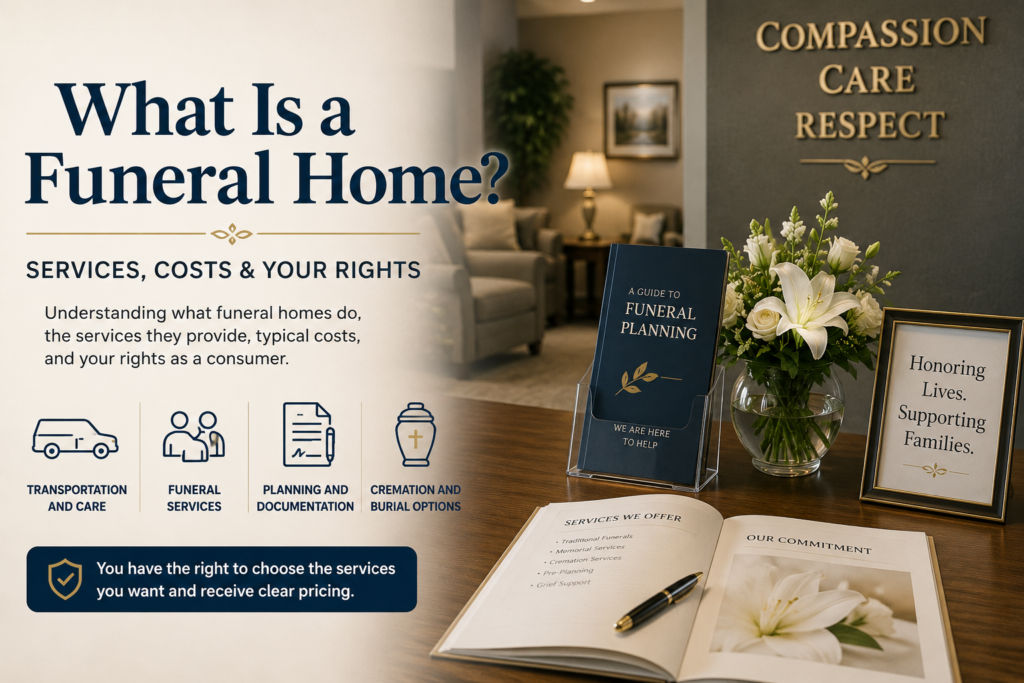
If you have never had to arrange a funeral before, the term funeral home can be confusing. You may know that funeral homes help families after a death, but you may not know exactly what happens there, what services they provide, what a funeral director does, or which services you are actually required to purchase.
A funeral home is a business or facility that helps families coordinate funeral-related services after someone dies. Depending on the provider, those services may include transportation, preparation of the deceased, visitation, funeral ceremonies, cremation arrangements, burial coordination, paperwork, and administrative support.
The exact services and legal requirements vary by location.
In the United States, the Federal Trade Commission’s Funeral Rule gives consumers important rights when dealing with funeral providers, including the right to receive price information and choose only the goods and services they want, subject to applicable legal requirements.
Understanding what a funeral home does can make an emotionally difficult process easier to navigate.
What Is a Funeral Home?
A funeral home is a facility and service provider that assists families with arrangements following a death.
Funeral homes may coordinate some or all of the practical, ceremonial, and administrative aspects of a funeral or cremation.
Services can include:
- Transporting the deceased
- Caring for the deceased
- Funeral or memorial planning
- Visitation
- Funeral ceremonies
- Cremation coordination
- Burial coordination
- Obituary assistance
- Permits and documentation
- Cemetery coordination
Not every funeral home provides exactly the same services.
What Does a Funeral Home Do?
The role of a funeral home is broader than simply providing a location for a funeral.
Transportation
A funeral provider may coordinate transportation of the deceased from the place of death to the funeral home or another appropriate facility.
Care and Preparation
Depending on the family’s choices and local requirements, the funeral home may provide preparation and care services.
These may include:
- Washing and dressing
- Preservation
- Embalming where selected or required
- Preparation for viewing
Embalming is not universally required in the United States. The FTC notes that state laws differ and that consumers should ask what alternatives are available.
Visitation
A funeral home may provide space for family and friends to gather before the funeral or memorial service.
Funeral Ceremony
Some funeral homes provide facilities and staff for ceremonies.
The service may be religious, secular, cultural, private, or highly personalized.
Cremation Arrangements
Some funeral homes operate crematories themselves, while others coordinate with third-party crematories.
Burial Coordination
Funeral providers may coordinate with:
- Cemeteries
- Clergy
- Transportation providers
- Crematories
- Florists
- Musicians
- Other service providers
What Is a Funeral Director?
A funeral director is a professional who helps coordinate funeral arrangements.
Their responsibilities can include:
- Meeting with the family
- Organizing services
- Completing paperwork
- Coordinating transportation
- Communicating with cemeteries or crematories
- Managing schedules
- Explaining available options
Licensing requirements vary by jurisdiction.
What Services Do Funeral Homes Offer?
The service menu differs by provider, but common categories include:
| Service | What it may involve |
|---|---|
| Basic services | Planning and coordination |
| Transportation | Moving the deceased |
| Preparation | Care and preparation for viewing |
| Visitation | Facility and staff for gathering |
| Funeral ceremony | Space, equipment and coordination |
| Cremation | Arrangements with crematory |
| Burial | Coordination with cemetery |
| Documentation | Permits and certificates |
| Merchandise | Caskets, urns and related products |
The FTC’s consumer guidance explains that funeral costs can include a basic services fee, additional services and merchandise, and cash-advance items.
Do You Have to Use a Funeral Home?
The answer depends on local law and circumstances.
The FTC states that in most U.S. states, consumers are not legally required to use a funeral home to plan and conduct a funeral, although families may choose professional assistance because of the complexity involved.
State and local requirements can differ, so legal questions should be checked against the relevant jurisdiction.
How Much Does a Funeral Home Cost?
There is no single funeral-home price.
Costs depend on:
- Location
- Services selected
- Burial or cremation
- Merchandise
- Transportation
- Facility use
- Cemetery costs
- Third-party services
- Required permits
- Optional preparation
The FTC recommends comparing providers and requesting itemized pricing.
What Is a General Price List?
A General Price List, commonly called a GPL, is an itemized list of funeral goods and services and their prices.
Under the FTC Funeral Rule, funeral providers covered by the rule must provide consumers with a General Price List when requested.
This is particularly important because families often make decisions under emotional pressure.
A written price list makes comparison easier.
Can You Buy a Casket Somewhere Else?
Under the FTC Funeral Rule, a covered funeral provider generally cannot refuse to handle a casket or urn purchased elsewhere or charge a fee simply for handling that outside purchase.
Consumers should still verify current legal requirements and provider policies applicable to their situation.
Funeral Home vs. Cemetery
These are not necessarily the same thing.
A funeral home primarily provides funeral-related services.
A cemetery is a place where burial or interment takes place.
Some businesses may operate multiple related services, but they serve different functions.
Funeral Home vs. Crematory
A funeral home coordinates funeral arrangements.
A crematory performs cremation.
Some funeral homes have cremation facilities, while others use independent or affiliated crematories.
If cremation is being considered, ask which organization performs it and what services are included.
How to Choose a Funeral Home
Choosing a funeral home does not need to be based entirely on reputation or proximity.
Consider:
Price Transparency
Can they provide clear, itemized pricing?
Services
Do they provide the type of ceremony or disposition you want?
Communication
Are staff willing to answer questions clearly?
Location
Is the facility practical for the family?
Cultural or Religious Needs
Can the provider accommodate relevant customs?
Flexibility
Can you select individual services rather than being pushed toward an unwanted package?
The FTC specifically says consumers can choose the funeral goods and services they want, subject to certain exceptions.
Questions to Ask a Funeral Home
Before agreeing to arrangements, ask:
- What is the basic services fee?
- What services are included?
- What services cost extra?
- Are there third-party charges?
- What are the burial or cremation options?
- Is embalming required?
- Can I receive the price list?
- Can I purchase merchandise elsewhere?
- What paperwork will you handle?
- Are there cancellation or payment terms?
Common Mistakes Families Make
Choosing the First Provider
Emotional circumstances can create pressure to make an immediate decision.
When possible, compare multiple providers.
Not Asking for Itemized Prices
Packages can make it difficult to understand what you are actually paying for.
Assuming Every Service Is Required
Some services may be optional while others may be required by applicable law.
Ignoring Third-Party Fees
Cemetery, crematory, permit, transportation, or other costs may be separate.
Frequently Asked Questions
What is a funeral home?
A funeral home is a professional service provider that helps families coordinate arrangements following a death, including transportation, preparation, ceremonies, cremation or burial coordination, and related administrative services.
What does a funeral home do?
A funeral home may coordinate transportation, preparation, visitation, ceremonies, documentation, burial, cremation, and communication with cemeteries and other providers.
Is a funeral home required?
Requirements vary by jurisdiction. In most U.S. states, the FTC says families are not generally legally required to use a funeral home to plan and conduct a funeral, although other laws may apply.
What is a funeral director?
A funeral director is a professional who helps families organize funeral arrangements, coordinate providers, handle documentation, and manage the practical details surrounding services.
Do funeral homes provide cremation?
Some do. Others coordinate cremation through a separate crematory.
Can I compare funeral home prices?
Yes. The FTC encourages consumers to compare funeral providers and provides specific rights concerning itemized pricing under the Funeral Rule.
Conclusion
Knowing what a funeral home is can make an unfamiliar process easier to understand.
A funeral home can provide much more than a location for a ceremony. It may coordinate transportation, preparation, visitation, paperwork, burial, cremation, and communication with other providers.
Families should also understand that they have choices. In the United States, the FTC Funeral Rule provides important consumer protections concerning pricing and the selection of funeral goods and services.
Because laws vary by jurisdiction, families should verify local requirements. When comparing providers, request itemized pricing, ask questions, and choose only the services that genuinely fit the family’s needs.